

Guides
ARTOS Fencing Piste

ARTOS Fencing Piste
Fencing is a sport that is not widely known, yet it is highly fascinating. Many people are unaware of the amount of work involved, both athletically and technically. One person who has invested extraordinary effort into this sport is Steffen Grollmisch. He and his company, ARTOS, have revolutionized the concept of the fencing piste.
About Steffen Grollmisch
Grollmisch was once a fencer himself. He began fencing at the age of seven and was even part of the GDR national team in 1987/88. Later, he became a coach. Yet one question never left him:
“How can I improve and further develop the materials used in this sport?”
This question transformed his hobby into a lifelong passion.
After developing several prototypes with a friend, the idea for a company emerged. He first founded a sole proprietorship, which later grew into a GmbH & Co. KG.
Thanks to continuous research and development, ARTOS has become highly successful. Demand for its innovations is strong both nationally and internationally. To meet production needs, the products must be manufactured industrially — something Grollmisch has achieved not only in fencing pistes but also through national and international partnerships, including in modern pentathlon. ARTOS enjoys an excellent reputation and continues to evolve.
The Idea Behind the New Fencing Piste
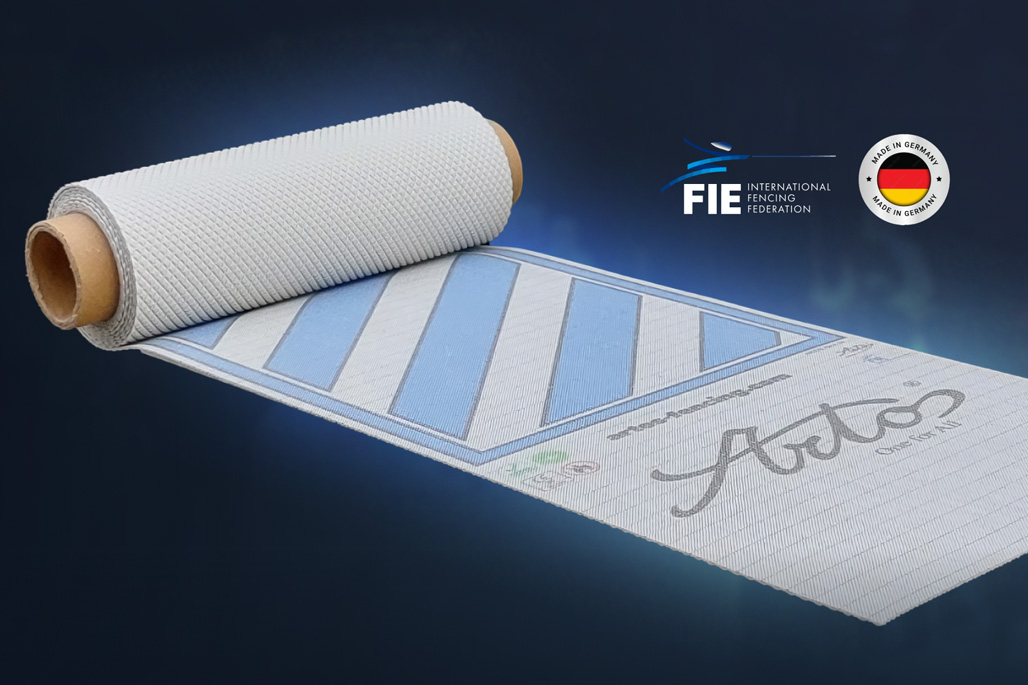
A fencing piste is 14 m (45.93 ft) long and 1.50 m (4.92 ft) wide. It is made of conductive material so that hits on the floor are not registered. Traditional pistes are often made of copper mesh and weigh around 70 kg (154 lb). There are also aluminum and steel versions. However, the most important factor is safety — the athlete must not slip and risk injury.
With this in mind, Grollmisch developed a new piste that is both slip-resistant and durable. The new piste weighs only 24 kg (53 lb), making it extremely easy to transport. Another key aspect is the color design. With the rise of color television, new media requirements emerged. The introduction of colors such as yellow, green, red, and blue created new presentation possibilities. The pistes could now be printed on and no longer produce optical reflections. Of course, traditional colors remain available. Grollmisch even obtained a patent for his concept.
Through continuous development, ARTOS has made Grollmisch one of the industry leaders.
Materials and Sustainability
Grollmisch works with various service providers, including those responsible for weaving the piste. The weaving machines come from a company in Saxony, an important partner that enables testing under extreme conditions. These tests include abrasion resistance, impact resistance, and odor prevention for silver-based materials. The findings are also relevant for other products.
Environmental friendliness is a major priority. German regulations ensure sustainability. The materials are durable, fire-resistant, and do not break or tear.
Key material properties:
- Rubberized, non-slip underside
- No chemical odors or substances emitted
- Electrically conductive top layer
- Impact- and tear-resistant middle layer
The Development Process
The development process began in 1992/93 with the search for a more flexible material. The first attempt used carbon fabric, but it lacked conductivity and was too smooth.
A visit to Techtextil in Frankfurt was meant to provide answers, but specialists there could not offer a solution. Only through a friend in the USA was a suitable yarn developed. Grollmisch had this yarn produced and woven.
However, problems arose. The conductive fabric created friction in the machine, generating high voltage that caused equipment hazards and production stoppages. Only after the machine was further developed could production continue. Another issue was the strong attraction of dust and particles due to static charge, which led to contamination — but this was quickly resolved.
The prototypes were tested in Halle/Saale at what is now the Halle Fencing Center and received positive feedback. However, production was initially too expensive. By optimizing the use of silver, the product became competitive.
The entire development process took 8 years.
Breakthrough and Success
Grollmisch revolutionized the fencing piste. He completely reinvented it.
Sales increased significantly thanks to user feedback. The decisive breakthrough came at the 1996 Olympic Games in Atlanta, where the pistes were used for the first time to improve hit visibility for both athletes and spectators.
“It was definitely worth creating such a piste,” Grollmisch says today, after many years of continuous development. Because he developed the idea independently, he still invests considerable effort in finding partners to further advance the product.
It has been a long journey as a self-investor to reach this point — a journey that has undoubtedly benefited both fencers and ARTOS.

About Steffen Grollmisch
Gründer und geschäftsführende Direktor von ARTOS Fencing, Entwickler der patentierten Fechtbahnen und innovativer Fechtsport‑Technologien sowie international engagierter Funktionär und ehemaliger National‑Fechter.
View all posts by Steffen Grollmisch References
 Global Activities
 Steffen Grollmisch
 ARTOS History