

Guides
Tips for choosing the right fencing weapon

Épée, Foil and Sabre at a Glance
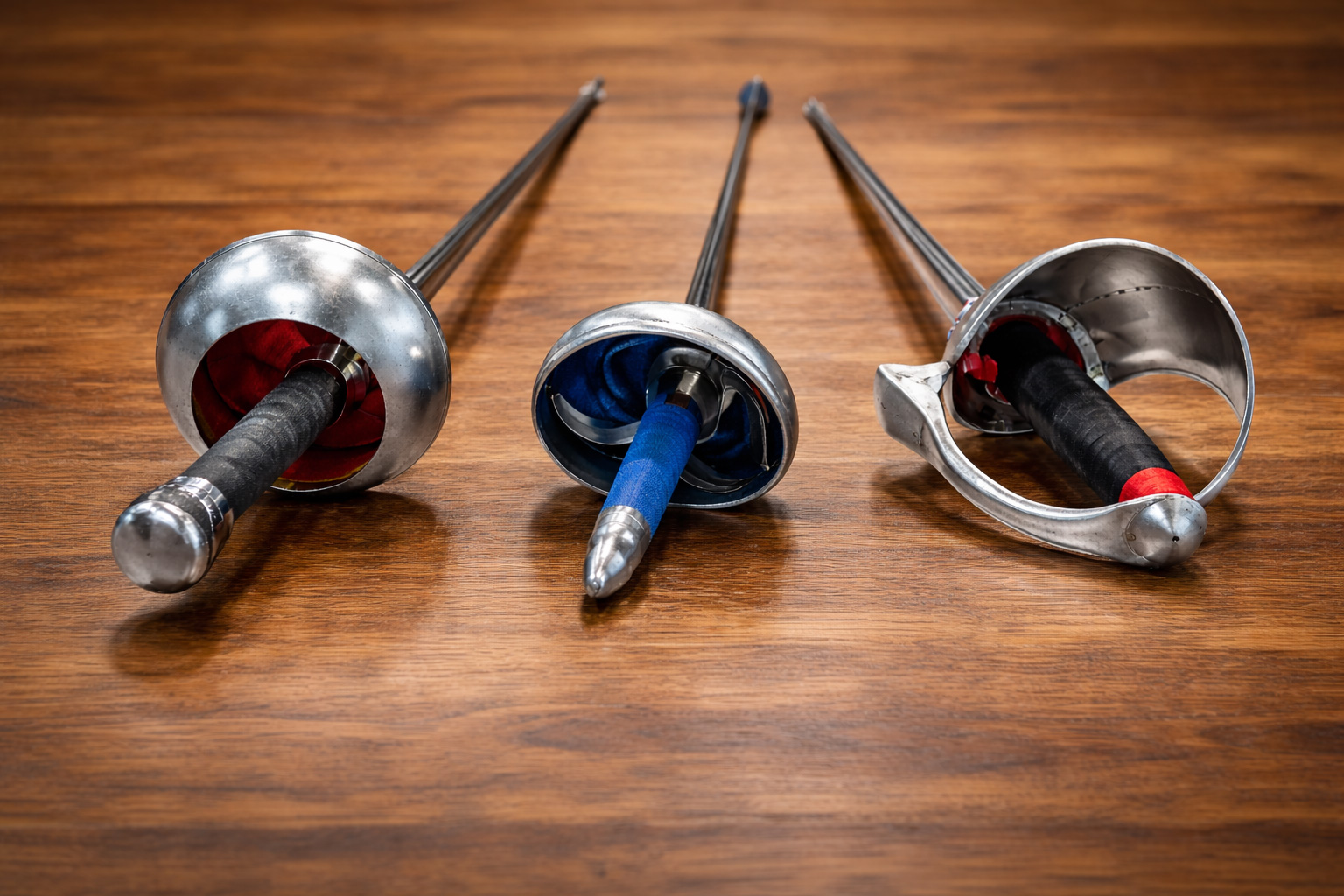
In the sport of fencing, there are several types of fencing weapons. These include the épée, the foil and the sabre. Each weapon has its own characteristics and is used in its own way in sporting competitions.
The Three Fencing Weapons in Detail
The Épée as a Fencing Weapon
The épée is an elastic, three-sided thrusting weapon. It features a half-shaped guard at the grip, which protects the fencer’s hand against the opponent.
Construction and Characteristics
Guard:
- Half-shaped
- Diameter: approx. 13.5 cm
Grip:
- French grip: long and smooth
- Pistol grip: hand-fitted
Blade:
- V-shaped cross-section
- Spring-loaded tip for electric hit registration
Sizes
Small épée (children’s épée): up to 90 cm in length
Full-size épée: up to 110 cm in length
Hit Registration
A hit is electronically registered when a force exceeding 750 grams is applied.
The Foil as a Fencing Weapon
The metal grip of the foil can be either coated or wrapped in textile.
Grip Types
- Orthopedic grip: hand-fitted
- French grip: shaft curved inward
- Italian grip: straight shaft
Hand Guard
The grips end at the front with the hand guard, known as the bell guard.
Size: 9.5 to 12 cm
Blade
- Material: spring steel
- Length: up to 90 cm
- Maximum curvature: 1 cm
- The degree of curvature determines the thrust force
Electric Foil (E-Foil)
The tip is axially movable and spring-loaded.
Tip:
- Diameter: approx. 8 mm
- Hit activation: at thrusts of at least 500 grams
Wiring
Near the back of the hand, a connector is attached to the weapon and connected to a cable. This runs along the arm to the back, where it is joined to the cable clip on the contact vest for torso hits, and then runs behind along the piste.
Note: At many tournaments today, wireless fencing is already in use, particularly at international competitions.
The Sabre as a Fencing Weapon
The sabre is equipped with a flexible, flat blade with a rectangular cross-section.
Characteristics
- Length: 88 to 105 cm (maximum length)
- Weight: limited to 500 grams (usually considerably lighter)
- Blade narrows toward the tip
Guard and Knuckle Bow
Special features:
- Half-dome shaped guard (visually distinguishable from other weapons)
- Prominent knuckle bow as additional protection against cuts
Grip
The grip has no finger grooves, allowing for greater freedom of hand position.
Wear Parts of a Fencing Weapon
Regular use can cause wear to the tip of the fencing weapon. The foil tip head, for example, can be replaced, so high-quality replacement parts can be sourced quickly.
Replaceable Parts on the Foil
- Tip head
- Guards (various quality levels: titanium or aluminum)
- Grips
- Body cords (in case of kinking, wear, or damage)
Replaceable Parts on the Épée and Sabre
- Tips
- Guards
- Grips
Tips for Choosing the Right Fencing Weapon
The Foil – Ideal for Beginners
Advantages:
- Light weight
- Easy to handle
- Ideal fencing weapon for beginners
- Elegant design (also suitable for experienced fencers)
- Suitable for demanding exercises
Characteristics:
- Pure thrusting weapon
- Guard protects the hand
The Épée – The Further Development
The épée is a further development of the sword. It generally has the highest weight of the three weapons. Some basic knowledge of fencing is an advantage when handling it.
Historical note: Traditionally, the foil was used as a training weapon for the épée due to its lighter weight. Today, the difference is no longer as significant as it was in the early days of fencing.
The Sabre – Versatile and Demanding
The sabre differs notably from the other weapons. It is not a pure thrusting weapon – cuts are also permitted.
Special features:
- Both thrusts and cuts are permitted
- Overall length is usually slightly shorter than the other weapons
- Wider range of techniques
- Beginners often prefer the épée over the sabre
The Different Target Areas
In sporting competitions, different areas of the body are valid target zones depending on the weapon used. This is an important consideration when selecting a weapon, as the target area influences the style of combat.
Target Areas at a Glance
FOIL
- Entire torso
- Groin
ÉPÉE
- Entire body (maximum target area)
SABRE
- Torso
- Head
- Arms
Care and Maintenance of the Fencing Weapon
Since fencing weapons are largely made of metal or steel, regular inspection is essential.
Important Maintenance Notes
Protection from moisture:
It is important to prevent moisture from forming on the weapon, as this can cause rust damage.
Cleaning:
- After use
- After extended periods of non-use
Storage:
The storage location for the sabre, foil and épée must be protected and dry.
Left-Handed and Right-Handed Fencers
Approximately 10 percent of the population are left-handed, while 90 percent are right-handed. In fencing, you can fence with either the left or the right hand.
Important when purchasing: Fencing weapons are often available in different versions to meet the respective requirements. When buying, you must therefore pay attention to whether the weapon is designed for left-handed or right-handed fencers.
Choosing the Right Fencing Weapon
When starting out in fencing, you should first familiarize yourself with all three types of weapons at a fencing club. Preferences are often discovered early on, and one weapon may be favored from the outset.
Recommendation: In general, the foil is considered a good entry-level weapon, but the épée and sabre are also suitable options. Since the sabre offers a broader range of techniques, beginners often prefer the épée over the sabre.
Summary – The Three Weapons Compared
FOIL
Length: up to 90 cm
Weight: light
Combat type: Pure thrusting weapon
Target area: Torso and groin
Hit registration: from 500 g
Ideal for: Beginners
ÉPÉE
Length: up to 110 cm (full-size) / up to 90 cm (small)
Weight: heavy (highest weight)
Combat type: Thrusting weapon
Target area: Entire body
Hit registration: from 750 g
Ideal for: Advanced fencers
SABRE
Length: 88 to 105 cm
Weight: max. 500 g (usually lighter)
Combat type: Thrusting AND cutting weapon
Target area: Torso, head, arms
Special feature: Freer grip position
Ideal for: Experienced fencers

About Steffen Grollmisch
Gründer und geschäftsführende Direktor von ARTOS Fencing, Entwickler der patentierten Fechtbahnen und innovativer Fechtsport‑Technologien sowie international engagierter Funktionär und ehemaliger National‑Fechter.
View all posts by Steffen Grollmisch References
 Global Activities
 Steffen Grollmisch
 ARTOS History