


Guides
Types of Fencing Pistes

What is a Fencing Piste?
A fencing piste is the designated area on which fencing bouts take place. Internationally, the term “Piste” is used. In German-speaking countries, it is also known as a “Planche”.
Dimensions and Markings
Standard Dimensions
Length: 14 m (46 ft)
Width: 1.50 – 2 m (5 ft)
Markings
A fencing piste includes the following markings:
- Dotted center line
- Two starting lines, each 2 m (6.56 ft) from the center
- Two rear boundary lines, each 7 m (23 ft) from the center
- The last 2 m before each rear boundary line are marked in color
- A run-off zone of 1.5–2 m (5–6.5 ft) behind each end line (not part of the piste)
Rules Related to the Piste
Start and Restart
Fencers begin the bout at their respective starting lines and return to these lines after each valid or off-target hit.
Boundary Violations
Rear boundary line: If a fencer crosses the last 2 m (6.56 ft) of their side with both feet, the opponent is awarded a point.
Side line: If one foot crosses a side line, the opponent gains one meter of piste, and the offending fencer must retreat.
This can quickly lead to the end of the piste being crossed, which will inevitably result in a penalty hit.
Note: If a fencer repeatedly crosses the side line of the piste, the referee may ask them to fence in the middle of the piste.
Raised Pistes at Major Events
At major international competitions, semi-finals and finals are fenced on a raised piste:
- Platform height: 50 cm
- Safety zone: 25 cm on each side
Materials and Types of Pistes
Basic Principle
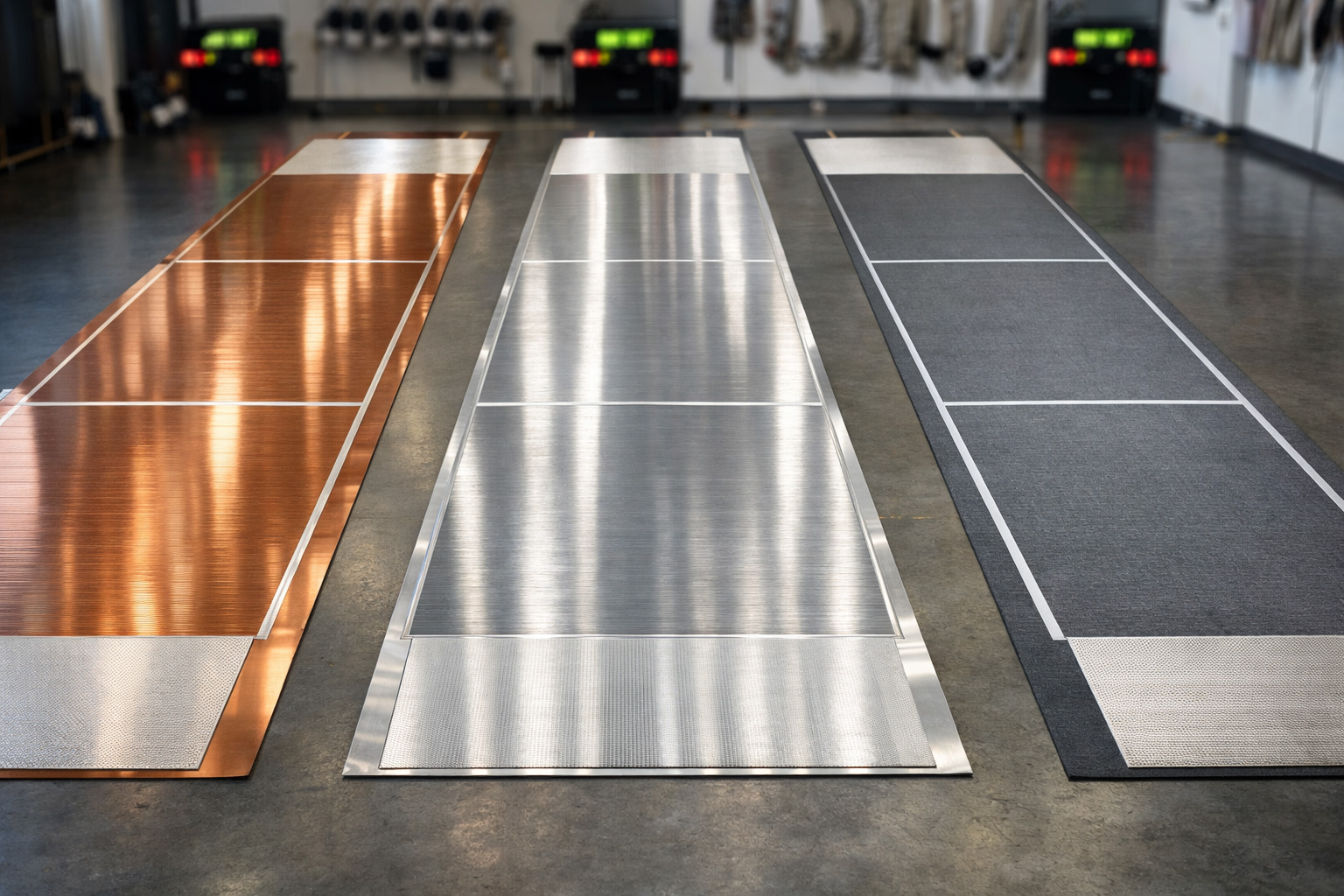
A fencing piste must be made of conductive material so that hits to the floor are not registered as valid by the scoring system. Several materials are used today, each with specific advantages and disadvantages.
Copper Alloy Pistes
Properties:
- Traditional and widely used
- Approximate weight: 70 kg
Disadvantages:
- High weight
- Poor environmental footprint
- Health concerns due to copper oxide
- High abrasion on shoe soles
Aluminum and Steel Pistes
These systems are commonly used for permanent indoor installations.
Advantages of the Aluminum Piste
- Lighter than copper alloy pistes
- Anti-glare surface
- Segmented design for easier installation
- High durability
- With careful maintenance, many years of use
- Resistant to holes and conductivity issues
Non-Slip Surface
Developed to provide optimal friction and maximum protection for fencing shoes.
Self-Locking System
The segments lock together securely, allowing full assembly in under 20 minutes.
Floor-Friendly Construction
The underside of each segment is covered with a soft, high-friction material:
- No additional fastening required
- Protects the floor from damage
- Suitable for almost all indoor surfaces
- No adhesive tape or fixing devices needed
- Cable ducts allow storage of cable reels beneath the piste
Disadvantages:
- High total weight
- Poor environmental footprint
- Health concerns due to aluminum oxide
- Low surface conductivity
- High abrasion on shoe soles
Textile Fencing Pistes – The Most Advanced Solution
Textile fencing pistes represent the most modern and innovative category of piste technology. They are woven with a fine wire mesh or with ARTOS SILVER textile threads made from 100% natural silver. These threads are extremely durable and provide excellent electrical conductivity.
Advantages
- Very low weight starting at 24 kg (53 lb)
- Significantly easier handling for tournaments and competitions
- Ideal for mobile use
- Fast setup in as little as 5 minutes
- Minimal use of adhesive tape
- Cost-efficient and environmentally friendly
- Supports the “Fencing for the Planet” initiative
- Customizable with full color printed logos
Installation on Different Surfaces
Sports Floors
- Roll out the textile piste.
- Align it precisely.
- Secure one end with adhesive tape.
- Tension the piste at the opposite end until smooth.
- Secure the second end with adhesive tape.
Stone Floors
- Lay down a soft underlayer (e.g., fleece) slightly smaller than the piste.
- Roll the piste out on top of the underlayer.
- Align and secure as described for sports floors.
Uneven Surfaces
- Create a level base using 18 panels (1 m × 2 m / 3.3 ft × 6.6 ft) of pressed cardboard or wood.
- Place the panels edge-to-edge and tape them together crosswise.
- Tape the panels lengthwise for stability.
- Roll out the piste and secure both ends with adhesive tape.
Care and Maintenance of Textile Fencing Pistes
To ensure long-lasting performance, textile pistes should be cleaned and maintained regularly.
Cleaning Based on the Degree of Soiling
Light Soiling
A broom or vacuum cleaner is sufficient after normal use.
Moderate Soiling (Small Stains)
Use a steam cleaner with:
- At least two 1000-watt heating coils
- Steam pressure of 5 bar
Heavy Soiling
Use a steam cleaner together with a citrus-based cleaning additive.
Repairing Damage
Method 1 – Repair Pen:
Use a conductive repair pen such as PELCO® Conductive Silver Paint.
Method 2 – Heat and Iron Method:
- Heat the damaged area.
- The fabric contracts.
- The adhesive softens.
- The mesh fibers expand.
- The damaged area closes.
- The adhesive cools and hardens.
- The defect is sealed.
Removing Chewing Gum
Use a freezing spray commonly used in sports medicine.
Important: The gum must harden before removal.
Alternative: Scrape it off carefully.
Summary – Comparison of Piste Types
COPPER ALLOY
+ Traditional and widely used
+ Stable, proven construction
– Very heavy (≈ 70 kg)
– Difficult to transport
– Higher abrasion on shoes
ALUMINUM / STEEL
+ Lighter than copper
+ Durable and robust
+ Non-slip surface
+ Self-locking system
+ Ideal for long-term setups
+ Gentle on floors
– Still relatively heavy overall
– Poor environmental footprint
TEXTILE (MOST ADVANCED SOLUTION)
+ Extremely light (≈ 20 kg)
+ Perfect for mobile use
+ Very fast setup
+ Modern, innovative technology
+ Supports sustainability goals
– Requires regular maintenance

About Steffen Grollmisch
Founder and Managing Director of ARTOS Fencing, developer of patented fencing pistes and innovative fencing technologies, as well as an internationally active official and former national-level fencer.
View all posts by Steffen Grollmisch References
 Global Activities
 Steffen Grollmisch
 ARTOS History